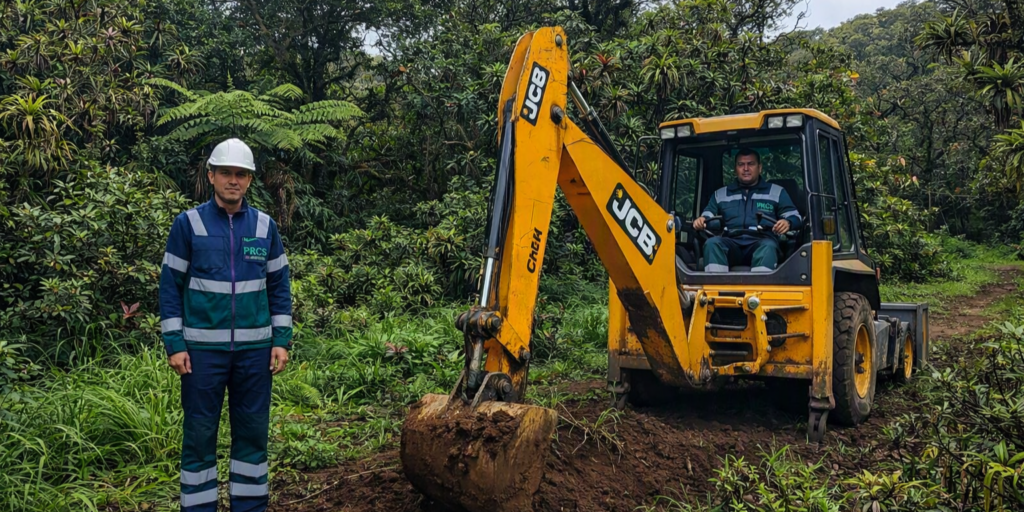
Comprehensive geotechnical exploration for the Sokporongchu Bridge site along the Nganglam-Gyalposhing Highway in Bhutan by PRCS.
Name of the Client:
Ministry of Works and Human Settlement
Project Description:
Detailed Sub-soil investigation of Sokporongchu bridge site at Chainage 29 km on the Nganglam-Gyalposhing Highway.
Scope of work:
- Collection of hydraulic data.
- Calculation of design discharge and Linear Waterway.
- Sub-soil exploration and determination of engineering properties of soil.
- Preparation of Sub-soil profile & Determination of bearing capacity of soil at various depths.
- Submission of Report.
Collection of Hydraulic Data
The collection of hydraulic data shall include collection of history of flood discharge, maximum HFL, maximum velocity of flood flow, river flow characteristics, rainfall intensity and catchments area and characteristics of catchment area.
The general guidelines provided in IRC: 5-1998 Clause 102.3 shall be followed in the collection of the hydraulic data. For hydrological data, the Hydromet Services Division of the Department of Energy may be consulted.
Calculation of Design Discharge and linear Waterway
The design discharge shall be calculated using minimum three methods as per the guidelines given in IRC: 51998 Clause 103. Similarly, linear water way shall be calculated based on the methods and the formula given in IRC: 5:1998 clauses 104.
Determination of borehole locations
The tentative borehole locations are shown in the Drawings attached. However, the Consultant shall decide the exact borehole location and depth for collection of sub-soil sample in consultation with Bridge Division.
Total of four bore holes shall be done- one each on the two abutments and the two arch foundations. The depth of the boreholes shall not be less than 20 mtr from the surface unless confirmed refusal is encountered prior to achieving the prescribed depth.
The engineering properties of the sub-soil strata at the location shall be worked out as detailed in the following pages
Sub-Soil Exploration and Determination of Engineering Properties of Soil
The boring for collection of sample shall be done at the proposed location of abutments and the arch foundations as per approximate span arrangement fixed.
The sub-soil investigation shall broadly consist of two stages, preliminary Investigation and Detailed investigation. In general the investigation procedure and collection of data shall follow the guidelines provided in IRC 78:2000. The scope sub-soil investigation in brief as as below;
(A) Preliminary Investigation
i) Preliminary investigation shall include the study if existing geological information, previous site reports, geological maps etc., and surface geological examination. These will help to narrow down the number of sites under consideration and also to locate the most desirable location for detailed sub-surface investigation.
(B) Detailed Investigation
i) Based on data obtained after preliminary investigations, the bridge site, the type of structure with span arrangement and the location and type of foundations, programme of detailed investigations, etc., shall be tentatively decided.
Thereafter the scope of detailed investigation including the extent of exploration, number of bore holes, type of tests, number of tests etc, shall be decided in close liaison with the design engineering and the exploration team, so that adequate data considered necessary for detailed design and execution are obtained.
ii) The exploration shall cover the entire length of the bridge and also at either end a distance of zone of influence i.e. about twice the depth below bed of the last main foundation to assess the effect of the approach embankment on the end foundations.
Generally the sub-surface investigations should extend to a depth below the anticipated foundation level equal to about one and a half times the width of the foundation.
However, where such investigations end in any unsuitable or questionable foundation material, the exploration shall be extended to a sufficient depth into firm and stable soils or to rock.
iii) The scope of the detailed sub-surface exploration shall be fixed as mentioned in B(i) and B(ii). However, as a general guide it shall be comprehensive enough to enable the designer to estimate or determine the following:
- Engineering properties of the soil/rock.
- Location and extent of weak layers and cavities, if any, below hard founding strata.
- The sub-surface geological condition, such as, type of rock, structure of rock i.e. folds faults, fissures, shears, fractures, joints, dykes and subsidence due to mining or presence of cavities.
- Ground water level.
- Artesian conditions, if any.
- Quality of water in contact with the foundation.
- Depth and extent of scour.
- Suitable foundation level.
- Safe bearing capacities of foundation strata.
- Probable settlement and probable differential settlement of the foundations.
- Likely sinking or driving effort and
- Likely construction difficulties.
(C) Method of taking soil sample
The size of the bores shall be predetermined so that undisturbed samples as required for the various types of tests are obtained. The method of taking samples shall be as given in IS: 1892 and IS: 2132. The tests on soil samples shall be conducted as per relevant part of IS: 2720.
Have a project that requires Geotechnical Investigation? Discuss Your Project With PRCS →
(D) Foundations Requiring Shallow depth exploration (Open Foundation)
These shall cover cases where the depth of exploration is not deep and it is possible to take samples from shallow pits or conduct direct tests like plate load tests etc. This will also cover generally the foundation soil for approach embankments, protective works etc.
(i) Tests shall be conducted on undisturbed representative samples, which may be obtained from open pits. The use of plate load test (IS: 1888 –Method of Load Test on soils) is considered desirable for ascertaining the safe bearing pressure and settlement characteristics.
A few exploratory bore holes or soundings shall be made a safeguard against presence of weak strata underlying the foundation. This shall extend to a depth of about 1½ times the proposed width of foundation
(ii) The test to be conducted at various locations for properties of soul etc., are different for cohesive and cohesion less soils. These are indicated below and shall be carried out wherever required according to soil type Cohesion less Soils
Laboratory Tests
- Classification test, index tests, density determination etc.
- Shear strengths by triaxial/direct shear etc.
- Field Tests.
- Plate Load Test.
- Standard penetration Tests (as per IS: 213).
Cohesive Soils
(a) Laboratory Tests
- Classification test, index tests, density determination etc.
- Shear strengths by triaxial/direct shear etc.
- Unconfined compression test (IS:2720 Part X)
- Consolidation test (IS: 2720 Part V)
(b) Field Tests
- Plate Load Test.
- Vane Shear Test (IS:4434)
- Static Cone Penetration Test (IS: 4968 Part III)
(E) Foundation Requiring Large Depth of Exploration
In this group are covered cases of deep open foundations, deep wells, pile foundations etc where the use of boring equipment, special techniques of sampling, in-situ testing etc., become essential.
In addition to the problems of soil and foundation interaction an important consideration can be the soil data required from constructions. Often in the case of cohesion less soils, undisturbed samples cannot be taken and recourse has to be made to in-situ field tests.
(i) The sub-surface exploration can be divided into three zones:
- Between bed level and up to anticipated maximum scour depth (below H.F.L).
- From the maximum scour depth to the foundation level and
- From foundation level to about 1½ times the width of foundation below it.
(ii) Sampling and testing (in-situ and laboratory) requirement will vary in each case and hence are required to be assessed and decided from case to case.
The subsoil water shall be tested for chemical properties to evaluate the hazard of deterioration to foundations where dewatering is expected to be required, permeability characteristics should be determined.
Determination of bearing capacity
Based on the field and laboratory test, the consultant shall suggest a tentative type of foundation to be adopted and calculate the bearing capacity of the soil at various founding level.
Submission of report
The report of the sub-soil investigation results shall be submitted in two stages viz. Preliminary report and Final Report.
Preliminary Report:
The preliminary report shall consist of the broad background sub-soil investigations. Site plan of the bridge site, proposed location of bridge axis and locations of each borehole shall be indicated in the report.
The overall presentation of the report shall conform to guidelines / specification provided in IRC 78:2000. The bore log chart and sub-soil profile shall be presented as per the guidelines in Sheet 1 and Sheet 2 of IRC 78, 2000 respectively. The relevant soil properties for design of foundation shall be listed distinctly supported by calculations wherever required.
Final Report:
On approval of the preliminary report by the competent authority of the department, the final report shall be submitted covering all the information as required in preliminary report with the modifications or additional data suggested by the department.
Have a project that requires Geotechnical Investigation? Discuss Your Project With PRCS →